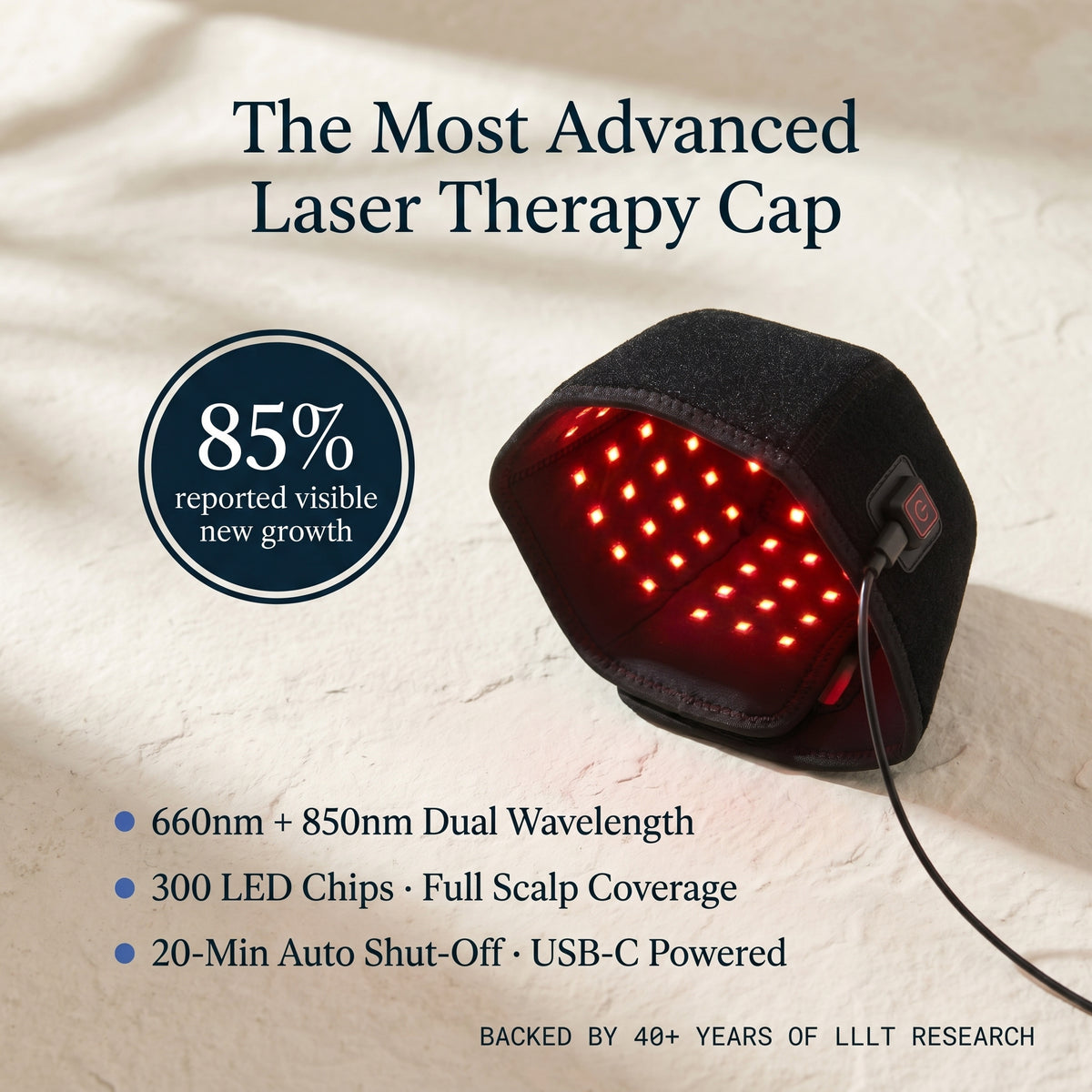
Clinic-Grade Laser Therapy — Without the $800 Price Tag
Dual-wavelength 660nm + 850nm laser therapy in a soft, USB-C cap. The exact wavelengths used in clinical hair-loss trials — 20 minutes, three times a week.
- 660nm + 850nm — surface and follicle root, every session
- 300 LED chips · 20-minute auto shut-off · USB-C powered
- Soft cap, fits all heads — wear it while you work, read, or watch TV
Replaces $800+ laser caps — same wavelengths.
Capillus, HairMax and iRestore use the same 660nm and 850nm wavelengths backed by published research. We just stripped out the markup and the plastic helmet.
Choose your protocol
Ships in 2–3 business days · Free US shipping on orders over $100
As Featured In
- Wavelengths
- 660 nm red light + 850 nm near-infrared. The two wavelengths most studied for hair growth.
- LED chips
- 300 chips total — 100 × 660 nm red + 200 × 850 nm infrared, in a 100-bead 3-chip array.
- Modes
- 3 — steady continuous · 10 Hz pulsed · 40 Hz pulsed.
- Session
- 20 minutes with automatic shut-off. 3–4 sessions per week.
- Power
- USB-C corded · 1.5 W in / 1 W out. Use any 5V phone charger or 10,000 mAh power bank.
- Form factor
- Soft neoprene-like fabric. Adjustable hook-and-loop closure. Packs flat.
- In the box
- Cap · USB-C cable · quick-start manual · gift box.
The dominant brands charge $500–$895 because they sell through dermatology clinics and licensed distributors. Strip out the clinic margin and the actual hardware cost is comparable to ours.
Capillus Ultra — $895. 82 lasers at 650 nm only. Single wavelength reaches the surface but not the follicle bulb. 3–4× clinic markup.
HairMax LaserBand 82 — $549. Must be combed through the scalp manually, 90 seconds per pass, three passes per session. Easy to skip. Single 655 nm wavelength.
iRestore Essential — $625. Only 51 LEDs total — sparse coverage. Hardware spec is below what’s now available direct-to-consumer.
Theradome PRO LH80 — $895. Rigid plastic helmet with an internal battery. When the battery fails after a few years, the device is dead. Ours is USB-C — replace the cable, not the cap.
- Plug in. Connect the USB-C cable to any 5V phone charger or power bank.
- Put on. Pull onto a clean, dry scalp. Adjust the hook-and-loop closure for a snug fit.
- Select mode. Short-press the power button to cycle: steady → 10 Hz → 40 Hz.
- Relax. 20 minutes, hands-free. Auto shut-off ends the session.
Frequency: 3–4 sessions per week. More isn’t better — LLLT follows a biphasic dose response, where over-treatment switches from stimulatory to inhibitory.
When you’ll notice changes: reduced shedding at 2–4 weeks, visible regrowth typically beginning at 12–16 weeks.
Low-level laser therapy (LLLT) at 655 nm + 808–850 nm has 40+ years of peer-reviewed evidence for androgenetic alopecia. The same wavelengths the $895 clinical caps cite.
Avci et al. (2014) — systematic review of 40 RCTs and clinical trials covering LLLT for hair growth. Found consistent effect across studies at 655 nm and 808 nm wavelengths.
Lanzafame et al. (2013) — 26-week randomized double-blind trial of 655 nm LLLT vs sham device. Active group showed +35% terminal hair density, statistically significant.
Munck et al. (2014) — review of LLLT for AGA, concluded the modality is safe and effective for both male and female pattern hair loss.
The modality has been FDA-cleared at the device level for AGA in both men and women. Studies were typically conducted with subjects on or off pharmaceuticals — the effect was independent.
Eye safety. LEDs face down into the scalp; your eyes are never directly exposed. Don’t operate upside-down or stare into the lit interior.
Don’t overuse. 20 minutes, 3–4× per week is the clinically-studied dose. More isn’t better. The 20-minute auto shut-off enforces this.
Cleaning. Wipe the interior with a slightly damp cloth weekly; let air-dry. Do not machine wash. Do not submerge.
Storage. Room temperature, away from moisture. Carrying pouch included for travel.
Consult a doctor first if — you are pregnant, have a pacemaker, take photosensitizing medication, or have a scalp condition under active dermatology care.
Specifications
Engineered for the wavelengths that matter.
Every spec on this page is on the product itself. No proprietary blends, no hidden “treatment levels,” no clinic gatekeeping.
Wavelengths
660 nm + 850 nm
Red light hits the scalp surface and upper follicle. Near-infrared penetrates 1–3 mm to the follicle bulb.
LED chips
300 total
100 lamp beads, each a 3-chip array (1× 660 nm + 2× 850 nm). Full-scalp coverage in 20 minutes.
Treatment modes
3 modes
Steady continuous · 10 Hz pulsed · 40 Hz pulsed. Vary the pulse profile across the week.
Session time
20 minutes
Auto shut-off after 20 minutes prevents overuse. 3–4 sessions per week.
Power
USB-C corded
1.5 W in / 1 W out. Use any phone charger or 10,000 mAh power bank. No battery to die.
Form factor
Soft cap
Neoprene-like diving fabric. Adjustable hook-and-loop closure. Fits all adult head sizes. Packs flat.
How it works
Light reaches the follicle. The follicle does the rest.
Low-level laser therapy (LLLT) is the same modality used in dermatology clinics for androgenetic alopecia. We didn’t invent it. We made it cost $349.
01 — DELIVERY
Photons enter the scalp.
660 nm red light is absorbed by chromophores at the scalp surface. 850 nm near-infrared travels 1–3 mm into the dermis and reaches the follicle bulb.
02 — RESPONSE
Mitochondria respond.
Cytochrome c oxidase absorbs the light and ATP production rises. Dermal papilla cells become more active. Inflammation drops, blood flow increases.
03 — RESULT
Follicles re-enter anagen.
Miniaturized follicles shift from telogen (rest) back to anagen (growth). Shed slows in 2–4 weeks. Visible regrowth typically begins at the 3–4 month mark.
Dual wavelength
Most caps use one wavelength. We use two.

660 nm Red visible
Hits the scalp surface and upper hair follicle. Drives ATP production in the cells around the follicle and reduces local inflammation. Same wavelength as the HairMax clinical trial.
850 nm Near-Infrared invisible
Travels 1–3 mm deeper to reach the follicle bulb itself — where dermal papilla cells live. Same wavelength range used in the Capillus and Theradome clinical literature.
Pulsed modes 10 Hz · 40 Hz
Pulsed light has been shown to deliver more energy per session at lower thermal load. Steady mode for daily comfort; 40 Hz mode for high-intensity weekly sessions.
Built for your exact situation
Replaces $800 laser caps. Replaces $2,800/yr in clinic visits.
Every laser cap on the market uses the same wavelengths backed by 40 years of LLLT research. Capillus charges $895. HairMax charges $549. iRestore charges $625. We charge $349 and put both 660 nm and 850 nm in every session.
Why most laser caps are overpriced
Same wavelengths. Half the price.
The dominant brands charge $500–$895 because they sell through dermatology clinics and licensed distributors. Strip out the clinic margin and the wholesale spread, and the hardware costs are honestly comparable.
Capillus Ultra
82 laser diodes at 650 nm only — single wavelength reaches the surface but not the follicle bulb. Sold through dermatology clinics with a 3–4× clinic markup.
HairMax LaserBand 82
Has to be combed through the scalp manually for 90 seconds per pass. Three passes per session, three sessions per week. Easy to skip — and the wavelength is single 655 nm.
iRestore Essential
51 LEDs total — sparse coverage relative to the scalp dome. Sold as a clinic device, but the hardware spec is below what’s now available direct-to-consumer.
Theradome PRO LH80
80 lasers at 678 nm. Rigid helmet form factor. Cordless via internal battery — when the battery fails after a few years, the device is dead. Ours is USB-C: replace the cable, not the cap.
The Comparison
The New Standard in At-Home Laser Therapy
See how our clinical-grade dual wavelength + soft fabric form factor stacks up against the rigid plastic helmets selling at clinic-margin prices.
| Follicle & Co. | Capillus UltraClinic-sold | HairMax LB 82Manual band | iRestore EssentialOTC helmet | Theradome PRO LH80OTC helmet |
|
||||
|---|---|---|---|---|---|---|---|---|---|
| Dual 660 nm + 850 nm wavelengths | Surface + follicle bulb | 650 nm only | 655 nm only | 650 nm only | 678 nm only | ||||
| Full-scalp LED coverage | 300 LED chips | 82 lasers | 82 lasers | 51 LEDs | 80 lasers | ||||
| Pulsed treatment modes | 10 Hz + 40 Hz | Continuous only | Continuous only | Continuous only | Continuous only | ||||
| Hands-free 20-min session | 6-min protocol | Manual combing | 25-min protocol | ||||||
| Soft fabric, packs flat | Neoprene-like, travel-friendly | Rigid plastic | Rigid band | Rigid plastic | Rigid plastic | ||||
| Replaceable cable, no battery to die | USB-C corded | Internal battery | Internal battery | AC adapter | Internal battery | ||||
| 90-day money-back guarantee | 30 days | 120 days | 12 months | 30 days | |||||
| Under $400 | $349 | $895 | $549 | $625 | $895 | ||||
Competitor specs from manufacturer pages, May 2026 · Prices in USD
Customer results
Real photos. Real timelines. No retouching.
Verified customers who used the cap for 5–8 months alongside their daily routine. Photos shared with consent — no AI generation, no stock imagery.
 Before
 After · 5 mo
Verified result · 5 months
 Before
 After · 7 mo
Verified result · 7 months
 Before
 After · 8 mo
Verified result · 8 months
Verified customers, photos shared with consent. Individual results vary — biology, consistency, and starting point all matter.
FAQ
What you should know before you buy.
How is this different from a $50 red-light cap on Amazon?
The cheap ones use a single wavelength (usually 660 nm only) and have 30–60 LEDs of unverified output power. This cap pairs 660 nm with 850 nm at 300 LED chips, and the 850 nm is what actually reaches the follicle bulb. It also has three pulse modes — a $50 cap is steady-on only.
Will this work if I’m already on minoxidil or finasteride?
Yes — LLLT works through a completely different mechanism (mitochondrial ATP production) than minoxidil (vasodilation) or finasteride (DHT inhibition), so it stacks well. Most clinical LLLT studies were conducted with subjects on or off pharmaceuticals; the effect was independent.
When will I see results?
Reduced shedding in 2–4 weeks is typical. Visible regrowth usually starts at 12–16 weeks. The published RCTs ran 24–26 weeks. Hair grows at ~½ inch per month, so anything faster than that isn’t biology — it’s marketing.
Is it safe for my eyes?
The LEDs face down into the scalp and the cap covers your full head — your eyes are never directly exposed. Don’t flip the cap upside-down and stare into it while it’s on, and don’t operate it without it being worn properly.
Can I use it more than 3 times a week to speed things up?
No. More isn’t better with LLLT — it follows a biphasic dose response. Too much light flips from “stimulatory” to “inhibitory.” 20 minutes, 3–4 times a week is the dose used in the studies that actually showed results. The 20-minute auto shut-off enforces it.
What if it doesn’t work for me?
Send it back inside 90 days for a full refund — no questions, no restocking fee. We pay the return shipping. We’d rather you not use a device that isn’t working for you than feel locked in.
Does it work for women?
Yes. LLLT is FDA-cleared as a modality for both male and female pattern hair loss. The cap is sized for all adult head shapes via the hook-and-loop closure. Suitable for Ludwig-Savin classifications I–II.
$349.00 · ONE-TIME · FREE US SHIPPING OVER $100
Start the protocol your follicles actually need.
20 minutes, 3 times a week. Same wavelengths as the $895 caps. 90-day money-back guarantee if it isn’t working for you.
Start My Protocol — $349.00