Formulation Science

The science behind Follicle & Co.

We started with the clinical literature, not the marketing brief. Every ingredient, every concentration, and every formulation decision in our system traces back to a published mechanism or a peer-reviewed study. This page explains exactly how and why our formula works. No hand-waving. No proprietary mystique.

Published Concentrations
6 Active Pathways
Microneedle Delivery
Every Study Cited

Delivery Mechanism

Why delivery matters more than dosage

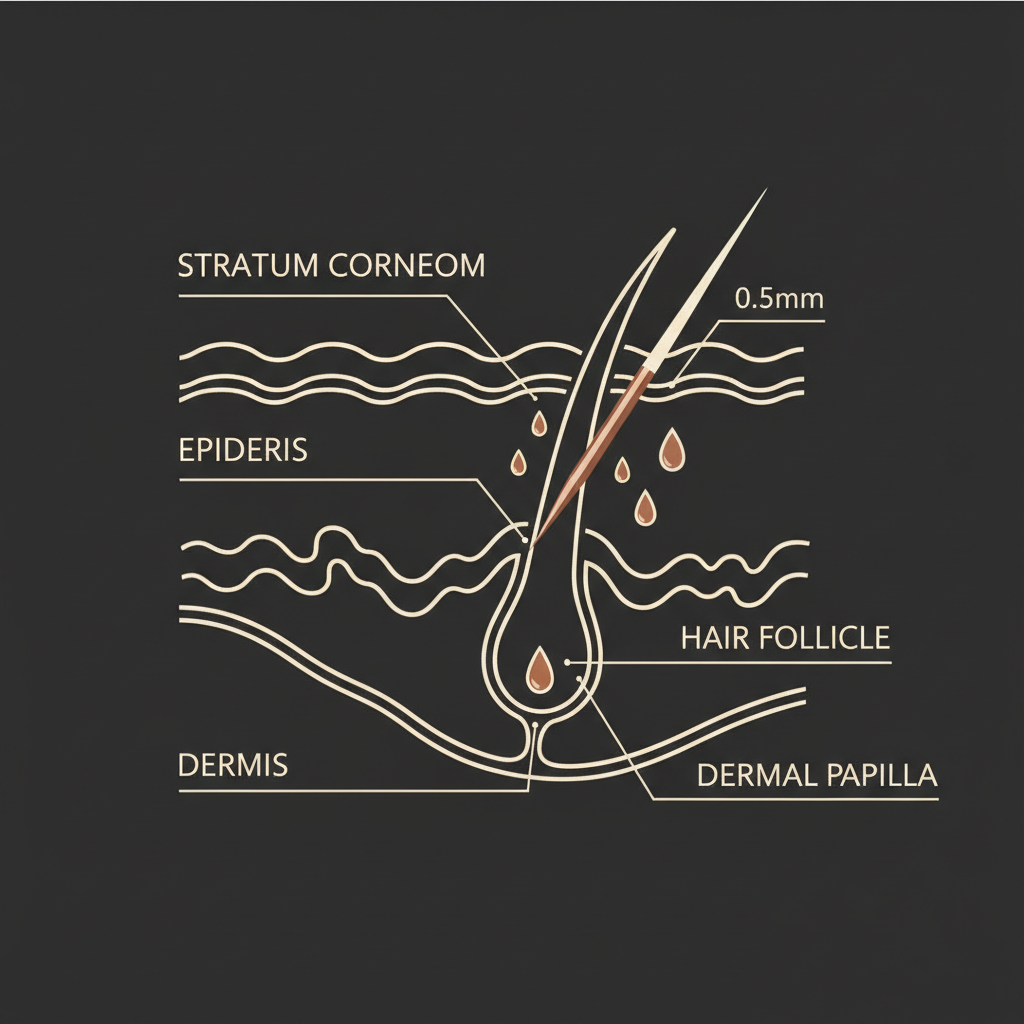
95%+ of topical actives never penetrate the skin barrier. They sit on the stratum corneum — a 10-to-15-micron layer of dead, flattened keratinocytes held together by lipid mortar. This layer exists specifically to keep foreign molecules out. Including the ones you paid for.

The target is the dermal papilla — a cluster of specialized mesenchymal cells at the base of the hair follicle that regulates the growth cycle. Between the stratum corneum and the dermal papilla sits roughly 0.5mm of tissue. That gap is the entire difference between a serum that works and one that sits on the surface and evaporates.

Our 0.5mm micro-infusion system creates hundreds of microchannels through the stratum corneum and into the upper dermis. The serum is dispensed directly through these channels as they form — bypassing the barrier entirely and delivering the full active payload to the dermal papilla and follicle stem cells.

This is why 0.05% GHK-Cu delivered intradermally can outperform 10% GHK-Cu applied topically. Concentration is irrelevant if the molecule never reaches the target. Delivery is the variable that changes everything.

Cross-section: microneedle penetrating stratum corneum to dermal papilla

Microneedle Specifications

Needle depth 0.5 mm
Needle gauge 32G (0.23 mm)
Needles per cartridge 20-36
Material Medical-grade titanium
Serum per cartridge 5.0 ml
Sterilization Gamma / EtO

Mechanism of Action

6 biological pathways. One system.

Hair loss is not a single-pathway problem. DHT is one factor, but follicle miniaturization involves stem cell dormancy, growth factor depletion, vascular insufficiency, and shortened anagen cycles. We target all six.

01

DHT Modulation

Procapil 2.5% + Capixyl 2.5%

Dual-mechanism 5-alpha-reductase inhibition at the follicle level. Procapil delivers Apigenin and Oleanolic Acid to reduce local DHT production. Capixyl provides Biochanin A, an isoflavone that modulates DHT signaling while Acetyl Tetrapeptide-3 remodels the extracellular matrix around the follicle. No systemic side effects.

View study

02

Stem Cell Activation

Redensyl 3.0%

Targets outer root sheath stem cells (ORSc) via dihydroquercetin-glucoside (DHQG) and epigallocatechin gallate-glucoside (EGCG2). Reactivates dormant follicles by triggering stem cell division and promoting re-entry into the anagen growth phase. The pivotal study showed a 17% increase in anagen hairs over 84 days at this concentration.

View study

03

Growth Factor Signaling

GHK-Cu 0.05%

Copper Tripeptide-1 activates the Wnt/beta-catenin signaling pathway — the primary molecular cascade governing follicle neogenesis and regeneration. GHK-Cu upregulates genes involved in tissue remodeling and growth factor expression. Delivered intradermally via microneedle, bypassing the bioavailability limitations of topical application.

View study

04

Anagen Prolongation

Adenosine 0.75%

Adenosine at this exact concentration was used in the landmark Japanese clinical trials that demonstrated measurable hair count increases. It increases the expression of fibroblast growth factor-7 (FGF-7) in dermal papilla cells, extending the active growth phase (anagen) and producing thicker, longer-lasting terminal hairs. Approved as a hair growth active in Japan.

View study

05

Anti-Testosterone Support

Caffeine 0.5%

Caffeine counteracts testosterone-driven suppression of hair matrix keratinocyte proliferation. In vitro studies show caffeine stimulates hair shaft elongation and prolongs anagen duration in human hair follicles exposed to testosterone. It acts as a phosphodiesterase inhibitor, increasing intracellular cAMP and overriding the suppressive signal.

View study

06

Vasodilation

Arginine 0.5% + Caffeine 0.5%

Arginine is a nitric oxide (NO) precursor. Nitric oxide relaxes perifollicular blood vessels, increasing oxygen and nutrient delivery to the follicle bed. Caffeine provides complementary vasodilatory support. Together they address the microvascular insufficiency that contributes to follicle miniaturization in androgenetic alopecia.

View study
11.5% total active load across all pathways

Ingredient Deep-Dives

Every ingredient. Every percentage. Every citation.

We publish our full formulation because transparency is not a marketing tactic — it is how a science-first brand earns trust. Each ingredient below is dosed at the exact concentration used in the referenced clinical study.

Redensyl

INCI: Dihydroquercetin-Glucoside (DHQG), Epigallocatechin Gallate-Glucoside (EGCG2), Glycine, Zinc Chloride

3.0%

Redensyl acts on outer root sheath stem cells (ORSc) — the progenitor cells responsible for regenerating the hair follicle during each growth cycle. DHQG stimulates the division of these stem cells, while EGCG2 targets dermal papilla fibroblasts to amplify growth signals. The result is reactivation of dormant follicles and a measurable shift from telogen (resting) to anagen (active growth).

Redensyl completes the RCP trio alongside Capixyl and Procapil. Each component acts through a distinct mechanism — stem cell activation, ECM remodeling, and DHT inhibition respectively — creating multi-pathway coverage from three complementary peptide complexes.

Clinical Reference

84-day double-blind, placebo-controlled study. 26 male volunteers. +17% increase in anagen (growing) hairs vs. baseline. -29% reduction in telogen (resting) hairs. International Journal of Cosmetic Science, 2014.

Chart: Redensyl anagen/telogen ratio shift over 84 days

Capixyl

INCI: Acetyl Tetrapeptide-3, Trifolium Pratense (Red Clover) Flower Extract

2.5%

Capixyl combines a biomimetic peptide (Acetyl Tetrapeptide-3) with a standardized Red Clover extract rich in Biochanin A. The peptide component remodels the extracellular matrix (ECM) surrounding the follicle by stimulating collagen and fibronectin production, strengthening follicle anchoring. Biochanin A is a potent isoflavone that inhibits 5-alpha-reductase, reducing the local conversion of testosterone to dihydrotestosterone (DHT) at the follicle level.

This dual mechanism addresses both the structural degradation and the hormonal signaling that drive follicle miniaturization in androgenetic alopecia. Capixyl modulates DHT without systemic hormonal effects — the inhibition occurs locally at the scalp.

Clinical Reference

In vitro: Biochanin A demonstrated significant 5-alpha-reductase inhibition. Ex vivo: Acetyl Tetrapeptide-3 increased ECM protein production in dermal papilla cells. Clinical study conducted by Lucas Meyer Cosmetics (now part of Clariant).

Chart: Capixyl ECM remodeling and DHT inhibition data

Procapil

INCI: Biotinyl Tripeptide-1, Apigenin, Oleanolic Acid

2.5%

Procapil is a three-component complex. Biotinyl Tripeptide-1 (Biotinyl-GHK) improves follicle anchoring by stimulating collagen synthesis in the perifollicular region. Apigenin enhances blood circulation to the hair root. Oleanolic Acid inhibits 5-alpha-reductase type I and II, reducing DHT accumulation at the follicle.

The combination provides structural, vascular, and hormonal support to the follicle simultaneously. Procapil works synergistically with Capixyl — both address DHT through different chemical pathways, and both strengthen the physical structure of the follicle through distinct ECM mechanisms.

Clinical Reference

4-month clinical study showing +121% improvement in hair growth rate vs. placebo. Demonstrated reduced hair loss and improved follicle anchoring. Sederma / Ashland, 2010.

Chart: Procapil hair growth rate improvement over 4 months

GHK-Cu (Copper Tripeptide-1)

INCI: Copper Tripeptide-1

0.05%

GHK-Cu is an endogenous human peptide that naturally declines with age. It activates the Wnt/beta-catenin signaling pathway — the master regulatory cascade for follicle neogenesis, wound healing, and tissue remodeling. GHK-Cu upregulates over 4,000 human genes involved in tissue repair, including growth factors critical for follicle cycling.

The concentration appears low at 0.05%, but GHK-Cu is a signaling molecule, not a structural ingredient. It operates at nanomolar concentrations. More critically, our microneedle delivery bypasses the stratum corneum entirely — delivering GHK-Cu directly to the dermal papilla where its receptors are located. Topical GHK-Cu at 10% may deliver less active peptide to the target site than our 0.05% delivered intradermally.

Clinical Reference

Pyo et al. demonstrated that copper tripeptide complex stimulated human hair follicle elongation ex vivo and proliferation of dermal papilla cells in vitro, while reducing DPC apoptosis (caspase-3 activity reduced 42.7%, PARP cleavage reduced 77.5%). Archives of Pharmacal Research, 30(7):834-9, 2007. Seoul National University.

Gene Expression Data

Pickart et al. identified GHK-Cu modulation of 4,000+ human genes associated with tissue remodeling, growth factor signaling, and Wnt/beta-catenin activation in follicle neogenesis models. Multiple publications, 2008-2018. Published in Cosmetics (MDPI), 2015 and BioMed Research International, 2018.

Diagram: GHK-Cu mechanism — Wnt/beta-catenin pathway activation in dermal papilla cells

Adenosine

INCI: Adenosine

0.75%

Adenosine is a purine nucleoside that increases the expression of fibroblast growth factor-7 (FGF-7) in dermal papilla cells. FGF-7 is a key paracrine signal that extends the anagen (active growth) phase of the hair cycle. The result is longer, thicker terminal hairs and a delayed transition to catagen (regression).

The 0.75% concentration matches the exact dosage used in the landmark Japanese clinical trials that demonstrated significant hair count increases in male pattern hair loss. Adenosine is approved as a quasi-drug hair growth ingredient in Japan based on this data. This is not an extrapolated or scaled concentration — it is the study concentration.

Clinical Reference

Randomized, double-blind trial in male androgenetic alopecia. Adenosine at 0.75% demonstrated significant increases in thick hair count and overall hair density vs. placebo. Approved as a hair growth active by the Japanese Ministry of Health.

Chart: Adenosine hair count data from Japanese clinical trial

Caffeine

INCI: Caffeine

0.5%

Caffeine is a phosphodiesterase inhibitor that increases intracellular cyclic adenosine monophosphate (cAMP) in hair matrix keratinocytes. Elevated cAMP counteracts the suppressive effect of testosterone on keratinocyte proliferation, effectively overriding the hormonal signal that shortens anagen and drives follicle miniaturization.

In vitro studies on human hair follicles demonstrated that caffeine stimulates hair shaft elongation and prolongs anagen duration even in the presence of testosterone. Caffeine also serves as a vasodilatory co-factor alongside Arginine, supporting increased blood flow to the perifollicular vasculature.

Clinical Reference

Fischer et al. demonstrated that caffeine at concentrations of 0.001%-0.005% stimulated human hair follicle growth in vitro and counteracted testosterone-induced suppression. International Journal of Dermatology, 2007.

Chart: Caffeine effect on hair shaft elongation vs. testosterone-only control

Formulation Engineering

The science behind the base vehicle

Active ingredients get the headlines. But the base vehicle, preservative system, packaging materials, and pH optimization determine whether those actives are still functional when they reach your scalp.

Trehalose for peptide stability 1.5%

Trehalose is a non-reducing disaccharide used in pharmaceutical formulations to protect protein and peptide structures during storage. It forms hydrogen bonds with peptide backbones, replacing water molecules and preventing denaturation. In our formula, Trehalose stabilizes the GHK-Cu tripeptide bond and the peptide components of Procapil and Capixyl over the 24-month shelf life. Without it, peptide degradation begins within weeks of manufacture.

Multi-hurdle preservative system

Peptide-containing aqueous formulas are challenging to preserve. A single preservative is rarely sufficient, and some preservatives interfere with peptide stability. Our system uses four components in concert: Phenoxyethanol 0.8% as the primary broad-spectrum preservative, Pentylene Glycol 2.0% as a co-preservative and mild penetration enhancer, 1,2-Hexanediol 1.0% for additional antimicrobial coverage, and Ethylhexylglycerin 0.4% as a preservative booster that amplifies Phenoxyethanol efficacy. This multi-hurdle approach has been challenge-tested against peptide interference from Zinc PCA and the copper peptide.

Polypropylene / COC cartridges — low protein binding

GHK-Cu adsorbs to many common packaging materials. PVC and uncoated glass surfaces bind copper peptides, gradually pulling active ingredient out of solution and onto the container walls. Our serum-contact surfaces use polypropylene or cyclic olefin copolymer (COC) — materials specifically selected for low protein binding in pharmaceutical applications. This ensures the GHK-Cu concentration in the last cartridge from a box is the same as the first. The reservoir seal is airtight to prevent copper peptide oxidation during storage.

pH optimization 5.2 — 5.5

The target pH range was selected to satisfy two constraints simultaneously. GHK-Cu is most stable between pH 5.0 and 6.0 — above or below this range, the copper ion dissociates from the tripeptide backbone. The scalp's natural pH is approximately 5.5. Our range of 5.2-5.5 sits at the lower end of GHK-Cu stability, maximizing peptide integrity while remaining fully compatible with the scalp's acid mantle. pH is adjusted using a citric acid / sodium citrate buffer system for precision and stability.

Solubilization system

Procapil and Capixyl both contain lipophilic fractions that are insoluble in water. PEG-40 Hydrogenated Castor Oil 1.5% acts as a non-ionic solubilizer, keeping these lipophilic components in stable suspension throughout the aqueous serum. Butylene Glycol 3.0% serves as a co-solvent and humectant, aiding dissolution of the remaining actives. Trehalose is dissolved in the water phase early in manufacture to ensure complete dissolution before peptides are introduced.

Radical Transparency

What we don't know

We haven't run our own clinical trial. We think it's more honest to state that clearly than to imply otherwise. Here is what we can claim, what we cannot, and what we plan to do about it.

What the data shows

Every individual active ingredient in our formula has published clinical or in vitro data at the concentrations we use. Redensyl at 3% showed a 17% increase in anagen hairs over 84 days. Procapil at 2.5% showed 121% improvement in growth rate. Adenosine at 0.75% demonstrated significant hair count increases in controlled trials. We cite those studies directly on this page.

What we don't have

We do not have a double-blind, placebo-controlled trial on our specific formulation as a whole. We cannot say with statistical certainty that these six actives combined via microneedle delivery produce additive or synergistic effects. The interaction between ingredients is theoretically complementary, but unproven at the system level.

What we plan to study

A proprietary clinical trial on the complete Follicle & Co. formulation is on our roadmap. We are planning a 6-month controlled study measuring hair density, anagen/telogen ratio, and hair shaft diameter using phototrichogram analysis. When we have the data, we will publish it — whether the results are favorable or not.

We believe ingredient-level evidence at published concentrations, combined with a validated delivery mechanism, is a reasonable basis for a product — but not a substitute for formulation-level data. We will always be transparent about the difference.

The formula speaks for itself.

Six pathways. Published concentrations. Microneedle delivery. 90-day money-back guarantee.

Shop Now
Free shipping over $100 No subscription required